





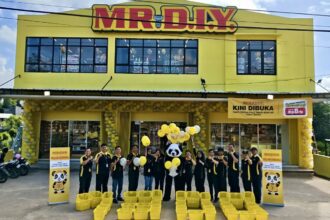
(Kuala Lumpur) — The most revealing thing about a hardware store is how little glamour it offers its owner. Shelves must be stocked with ordinary objects, from screws and electrical fittings to household tools and storage containers. Customers arrive with practical problems, and they expect to find the right product at a price they can afford. Tan Yu Yeh saw commercial potential in this unremarkable corner of retail. In 2005, he helped establish MR.DIY in Malaysia, building a business around the proposition that everyday household and repair products could be sold through a large, organized chain rather than a collection of disconnected small shops.
Tan’s professional background was not that of a lifelong shopkeeper. He had worked as an engineer and later as a stockbroker, experiences that exposed him to different ways of analyzing problems and evaluating businesses. Engineering rewards attention to systems and practical constraints; financial markets require an understanding of risk, valuation, and the expectations of investors. Neither discipline guarantees success in retail, but both can help an entrepreneur approach a business as a structure that must be designed, financed, and managed rather than simply opened.
MR.DIY entered a market in which traditional hardware shops already served local communities. Those businesses had an advantage in familiarity and personal service, but a modern chain could compete through wider product selection, consistent pricing, centralized procurement, and a recognizable store format. The opportunity was to make shopping for household necessities more predictable. Customers could visit a familiar-looking outlet, compare products across categories, and buy several items in one trip. The business model was built around frequency and convenience rather than dependence on a single expensive purchase.
The early challenge was to establish a format that could be repeated. A single store may succeed because its owner knows the neighborhood, negotiates personally with suppliers, and understands the preferences of regular customers. A chain must reproduce those advantages across different locations. It needs reliable inventory systems, standard store layouts, disciplined purchasing, and procedures for opening and operating new outlets. The founder’s task is to transform the local knowledge that helps one shop survive into a system that can serve customers across an entire country.
The assortment was central to the proposition. MR.DIY developed a broad range of products covering household goods, furnishings, hardware, stationery, electrical items, toys, and other everyday needs. This breadth encouraged customers to regard the store as a convenient destination for several small purchases rather than a specialist shop for one category. It also created operational demands: a large assortment requires careful product selection, supplier coordination, inventory monitoring, and decisions about which items deserve shelf space in stores serving different communities.
Price became another important part of the brand’s appeal. Many household purchases are relatively small, but their cumulative cost matters to families managing a budget. A retailer that offers accessible prices across a wide range of necessities can attract frequent visits and benefit from the combined volume of thousands of transactions. Maintaining that promise requires more than advertising. It depends on sourcing products efficiently, controlling logistics costs, managing stock, and avoiding the expensive accumulation of slow-moving inventory.
The chain’s expansion required a different kind of capital discipline from that of a small independent shop. Each new outlet creates upfront costs for rental deposits, fittings, inventory, staffing, and opening operations. Those expenses must be supported by a credible forecast of future sales. Expansion that moves too slowly can surrender attractive locations to competitors, while expansion that moves too quickly can leave the company with weak stores and excessive operating costs. The challenge is to identify locations where the retail proposition can work repeatedly, not simply to maximize the number of store openings.
MR.DIY eventually moved from a privately built retail operation to the public markets. The company listed on Bursa Malaysia in 2020, giving investors a way to participate in its growth and placing the business under the reporting requirements of a listed corporation. A public listing can provide capital and increase the visibility of a business, but it also changes the demands on management. Investors expect reliable financial information, clear capital allocation decisions, and evidence that the company can continue growing without sacrificing operating discipline.
The store network became the clearest expression of the strategy. Forbes reported in 2026 that MR.DIY had approximately 3,000 stores across Asia. The chain’s expansion demonstrated that the concept was capable of moving beyond its original Malaysian market. Yet a large store count is not sufficient evidence of success on its own. The quality of the network depends on sales per outlet, inventory turnover, occupancy costs, customer demand, and the company’s ability to maintain a consistent experience across thousands of locations.
The financial numbers illustrate the scale that the company reached. MR.DIY Group reported total revenue of approximately RM20.20 billion for 2025 in the annual-report information published for its Thai subsidiary, MR.DIY Holding (Thailand), which is a separate reporting entity and should not be confused with the Malaysian parent. The Malaysian group’s own financial highlights also show quarterly revenue figures exceeding RM1 billion in each quarter of 2025. These results establish the business as a major retail operation, although the precise consolidated annual revenue of the Malaysian parent should be taken from its own audited statements rather than inferred from the Thai subsidiary’s accounts.
For MR.DIY, purchasing is a strategic function rather than a back-office activity. When a retailer sells thousands of product lines, even small differences in procurement cost can have a meaningful effect on profitability. Supplier relationships, order volumes, quality checks, and shipping arrangements all influence the economics of the store network. Centralized buying can improve bargaining power, but it also requires a careful understanding of which products consumers actually want. The lowest purchase price is not always the best commercial decision if the product is unreliable or fails to sell.
The business must also make choices about inventory. A store filled with too much stock ties up capital that could be used elsewhere, while an empty shelf sends customers to competitors. Product availability is particularly important for a retailer built around convenience. A customer who cannot find a common household item may begin to doubt whether another trip will be worthwhile. MR.DIY’s challenge is therefore to balance breadth of assortment with the discipline to keep the right products available in the right places.
International growth adds another layer of complexity. A product that sells well in Malaysia may not have the same demand profile in another country. Consumer purchasing power, home sizes, climate, regulations, retail competition, and local supplier networks can all affect the assortment. A chain can preserve its core operating model while adapting its product range to local needs. The ability to distinguish between what should be standardized and what should be localized becomes increasingly important as the business crosses borders.
Retail is also a business in which technology can improve small decisions at enormous scale. Sales data can help managers identify fast-moving products, adjust orders, evaluate locations, and recognize changes in customer behavior. When a retailer operates hundreds or thousands of stores, even modest improvements in forecasting can reduce waste and improve product availability. The challenge is to ensure that data supports commercial judgment rather than replacing it. Local managers still need to understand the conditions that make a particular store different from the rest of the network.
For entrepreneurs considering a similar path, MR.DIY offers a lesson in the value of an unglamorous market. Household repair products are not fashionable in the way that technology platforms or luxury brands can be, but they serve persistent needs. A business does not require a revolutionary invention if it can organize an existing market more effectively. The opportunity may lie in making ordinary products easier to find, more consistently priced, and more conveniently available. That is a less dramatic proposition than disrupting an entire industry, but it can support a substantial enterprise when executed well.
Tan Yu Yeh’s achievement should also be understood in terms of the organization he helped create. The transition from a small retail concept to a listed regional chain required systems for purchasing, distribution, staffing, financial control, and site selection. The founder could not personally manage each store, and the company’s growth depended on building an organization capable of making thousands of daily decisions. The retail format became valuable because it could be reproduced without requiring the founder to recreate the entire business every time a new outlet opened.
The story of MR.DIY is ultimately a reminder that large businesses can emerge from markets that appear ordinary. Tan’s enterprise was built around products people need for maintaining homes and managing daily life, not a luxury product or a natural-resource concession. By organizing those needs into a recognizable retail format and expanding the network, he helped build a Malaysian company with regional reach. The future will depend on how effectively MR.DIY manages competition, store productivity, and expansion, but its rise already demonstrates the commercial power of disciplined execution in everyday retail.
INSIGHT :
- 01
- 02
- 03
- 04
- 05
- 06