




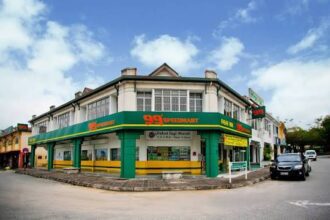
KUALA LUMPUR — 99 Speed Mart Retail Holdings Berhad has turned one entrepreneur’s ambition to sell everyday essentials into one of Malaysia’s largest retail businesses, with thousands of neighborhood stores, billions of ringgit in annual sales and a growing presence in the country’s listed-equity market. Founded by Lee Thiam Wah, the minimarket operator has built its position through a high-volume, convenience-driven business model that brings groceries, household products and other necessities within easy reach of residential communities.
The company, traded on Bursa Malaysia under the ticker 99SMART, reported revenue of RM6.14 billion, equivalent to approximately $1.50 billion, for the first six months of 2026. Net profit reached RM352.51 million, or about $86.4 million, as the retailer continued expanding its store network and increasing sales. The figures represent year-over-year growth of 15.5% in revenue and 21.8% in net profit, based on its latest reported financial results.
Lee’s story began in 1987, when he opened his first minimarket, Pasar Raya Hiap Hoe, as a sole proprietorship. He subsequently established a chain under the Ninety Nine Market name in 1992, operating under the Pasar Mini 99 brand. By 1998, the business had expanded to eight stores in Klang, Selangor, laying the foundation for a retail network that would eventually extend across Malaysia.
In 2000, Lee incorporated 99 Speed Mart Sdn Bhd to formalize the business and support a more ambitious expansion strategy. The company acquired the assets and assumed the liabilities of the earlier minimarket operation in 2003. Lee later established a separate vehicle for expansion into East Malaysia in 2013, extending the group’s geographic reach beyond its original base in the Klang Valley.
The retailer’s growth has been built around a straightforward proposition: sell frequently purchased products through conveniently located stores, maintain a broad assortment of everyday necessities and generate revenue through a large volume of relatively small transactions. Its neighborhood format places the business close to consumers making routine purchases, allowing it to compete for spending on groceries, beverages, packaged food and household essentials.
Unlike department stores and premium supermarkets, 99 Speed Mart emphasizes accessibility and frequent shopping trips. The model depends on purchasing power, inventory availability, distribution efficiency and the ability to serve a large customer base at competitive prices. Store-level economics and the productivity of its expanding network are therefore central to the company’s long-term profitability.
The business has also benefited from the scale of its distribution network. A large chain can consolidate procurement, improve supplier relationships and distribute merchandise across numerous outlets through a coordinated logistics system. These advantages become increasingly important as the retailer adds stores, although rapid expansion also requires capital expenditure, inventory investment, distribution capacity and effective management of operating costs.
The financial results illustrate the scale that the company has achieved. For the financial year ended Dec. 31, 2025, revenue rose 14.5% to RM11.43 billion, approximately $2.80 billion, from RM9.98 billion in 2024. Net profit increased to RM614.20 million, or about $150.5 million, from RM490.27 million a year earlier, according to the company’s reported results.
Gross profit advanced 17.6% to RM1.29 billion in 2025, while the gross profit margin improved by 0.3 percentage point to 11.4%. The number of outlets increased 9.3% year over year, and the company generated approximately RM49.7 million in additional revenue from its bulk-sales e-commerce platform. Total sales transactions rose 14.3% to 532 million, with an average basket size of RM21.50.
Performance remained strong in the first half of 2026. Revenue increased to RM6.14 billion from RM5.32 billion in the corresponding period of 2025, while net profit rose to RM352.51 million from RM289.53 million. The results indicate that the company continued to grow sales and earnings at a faster pace than revenue, although investors will need subsequent quarterly disclosures to assess whether that trend persists through the second half of the year.
For the second quarter ended June 30, 2026, revenue reached RM3.08 billion, up from RM2.71 billion a year earlier. Quarterly net profit increased to RM163.95 million from RM144.63 million. These figures put the business on a substantial earnings base before the release of its third-quarter results, which would provide a clearer indication of trading performance during the July-to-September period.
The company’s ownership structure also reflects its founder’s continuing influence. According to its 2024 annual report, Lee held a direct stake of approximately 28.18%, while Lee LYG Holdings Sdn Bhd owned 51.50%. Lee was also deemed to have an indirect interest in the shares held by the holding company. The two positions should not be added together as separate economic ownership without accounting for the underlying shareholding structure.
99 Speed Mart completed its initial public offering on Sept. 9, 2024, at RM1.65 per share, entering Bursa Malaysia’s Main Market under the 99SMART ticker. The listing gave public-market investors access to a consumer retail business whose growth had previously been driven primarily through private ownership. It also created a market valuation against which investors could assess the company’s earnings, expansion plans and dividend policy.
Dividends have become another part of the investment proposition. For the 2025 financial year, the company reported total dividends of 4.50 sen per share, compared with 1.25 sen in 2024. Its first-quarter 2026 results also recorded a proposed dividend of 2.25 sen per share. Dividend distributions provide shareholders with a direct return, although future payments will depend on earnings, cash requirements, capital expenditure and decisions by the board.
The company’s expansion strategy places it in a competitive segment of Malaysia’s consumer economy. Traditional neighborhood shops, independent grocers, supermarkets and other convenience-oriented retailers all compete for household spending. 99 Speed Mart’s large footprint gives it an advantage in geographic reach and purchasing scale, but maintaining consistent product availability and attractive prices across thousands of locations remains an operational challenge.
Digital commerce provides another avenue for growth. The contribution from the bulk-sales e-commerce platform suggests that the company is extending its reach beyond conventional walk-in transactions. The opportunity is to complement its physical network with additional sales channels while retaining the cost discipline required by a low-margin retail model. The long-term value of this channel will depend on its ability to generate incremental sales and profitable customer relationships.
INSIGHT :
- 01
- 02
- 03
- 04
- 05
- 06