




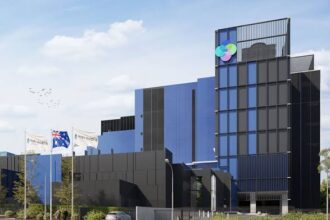
(Hong Kong) –– Macquarie Capital is expanding its investments in digital infrastructure across Asia-Pacific as demand for artificial intelligence (AI) computing and cloud services accelerates. On Oct. 6, 2026, Macquarie Capital announced an investment in Zerra DC, a hyperscale data center developer and operator with plans to develop more than 2 gigawatts (GW) of IT capacity across Australia, Japan and India.
Zerra was founded by AGP, a global real assets investment and asset management firm. Macquarie Capital’s investment will support the development of Zerra’s projects across Asia-Pacific, while AGP will remain the majority shareholder. The investment amount was not disclosed, but the deal expands Macquarie Capital’s exposure to a data center market benefiting from rising demand for AI infrastructure.
One of Zerra’s flagship projects is Western Downs Digital Park in Queensland, Australia. The development is planned to deliver up to 1.44 GW of IT capacity across four phases and has secured a long-term lease commitment from Anthropic, the AI company behind Claude. Zerra is also developing a proposed data center campus in Campbellfield, Melbourne, with planned power capacity of approximately 336 megawatts (MW).
In Japan, Zerra is planning a data center facility in Inzai, in the greater Tokyo area, with approximately 130 MW of planned IT capacity. In India, the company is preparing a project in Navi Mumbai with planned capacity of 240 MW. These three markets offer opportunities for Zerra to build a network of large-scale facilities serving technology companies, cloud providers and AI developers.
For Macquarie Capital, the Zerra investment reflects a direct investment strategy in digital infrastructure. Rather than limiting its involvement to financial advisory services or arranging financing, Macquarie Capital deploys its own capital to support businesses and platforms with long-term growth potential. Rising demand for AI computing is driving the need for large data center campuses with substantial power supplies and robust network connectivity.
Beyond Australia, Japan and India, the broader Macquarie group also has exposure to South Korea’s data center sector. In March 2026, Macquarie Asset Management (MAM), through Macquarie Asia-Pacific Infrastructure Fund 4, formed a partnership with South Korean IT company Gabia. The two parties plan to invest approximately 600 billion won, equivalent to about $420 million based on the announced estimate, over four to six years to develop a hyperscale data center platform with more than 100 MW of capacity.
The partnership’s first project is the 40 MW Ansan Data Center, designed to serve computing demand in the greater Seoul metropolitan area. Gabia, together with its subsidiary KINX, will oversee facility design, network construction, operations, maintenance and customer acquisition. MAM will lead asset management and financing, including land acquisition, permitting and funding arrangements.
Earlier, in August 2024, MAM, through Macquarie Korea Infrastructure Fund, agreed to acquire Hanam Data Centre near Seoul. The announced purchase price was 734 billion won, while the total transaction value, including costs and funding for the completion of mechanical, electrical and plumbing works, reached 918 billion won. The hyperscale colocation facility has a total capacity of 40 MW and is designed to meet corporate data storage and processing requirements.
Macquarie’s involvement in AirTrunk also represents a significant part of its Asia-Pacific data center investment track record. In 2020, a consortium led by MAM alongside PSP Investments acquired an 88% stake in AirTrunk, which then operated five data centers across Australia, Singapore and Hong Kong with a combined capacity of 450 MW. During their ownership, AirTrunk expanded into Japan and Malaysia and increased its contracted capacity to more than 1.8 GW.
Macquarie and PSP Investments subsequently agreed to sell their interests in AirTrunk to Blackstone in September 2024 in a transaction implying an enterprise value of more than A$24 billion. The exit illustrates an investment strategy that extends beyond building and expanding infrastructure platforms to realizing value once a business reaches greater scale. AirTrunk is now under new ownership and is no longer part of Macquarie’s portfolio.
At the group level, Macquarie’s digital infrastructure strategy extends beyond data center ownership. The firm also invests in fiber-optic networks, telecommunications towers and infrastructure connecting data centers with customers and cloud service providers. In Indonesia and across Southeast Asia, MAM has exposure to Bersama Digital Infrastructure, which develops opportunities in telecommunications towers, fiber-optic networks and data centers.
Macquarie Capital also has a track record of investing in PhilTower Consortium in the Philippines, an independent telecommunications infrastructure company expanding its cellular tower network. Although this is not a direct data center investment, it illustrates Macquarie’s broader approach to building a digital infrastructure ecosystem. Connectivity is essential to data center operations because it determines the speed, reliability and efficiency of data transmission.
Macquarie’s investment strategy centers on identifying markets with long-term demand growth, strong customer commitments and opportunities to build scalable assets. In the data center sector, investors must evaluate electricity availability, land access, fiber connectivity, permitting requirements and the ability to attract creditworthy tenants. Long-term lease agreements with major customers can provide greater revenue visibility and strengthen the financing case for individual projects.
Partnerships with local operators are another important element of this approach. Investors such as Macquarie can provide capital, financing expertise, asset management capabilities and access to institutional investment networks, while operating partners contribute local market knowledge, technology expertise, customer relationships and facility management. This division of responsibilities allows investors to expand without having to develop every operational capability from scratch.
However, rising AI demand does not eliminate investment risks. Data center development requires substantial capital expenditure, while electricity constraints, construction cost inflation, permitting delays and technological changes can affect investment returns. Announced development capacity also does not necessarily translate into operating capacity or facilities with secured customer contracts.
Competition for land, electricity and hyperscale customer commitments is likely to become a key determinant of success in Asia-Pacific’s data center market. Australia, Japan, India and South Korea offer different opportunities, ranging from large-scale AI computing requirements to growing corporate cloud demand. For infrastructure investors, site selection and contract structures are as important as the headline capacity of a proposed development.
Through its investment in Zerra, its partnership with Gabia, and its previous experience with AirTrunk and Hanam Data Centre, Macquarie is pursuing an approach that combines capital deployment, platform development, operating partnerships and investment lifecycle management. Its objective is not simply to increase the number of facilities but to build digital infrastructure assets capable of securing long-term customers and expanding alongside rising computing demand. The strategy positions data centers as an important component of Macquarie’s Asia-Pacific investment activity amid the growth of AI and the digital economy.
INSIGHT :
- 01
- 02
- 03
- 04
- 05
- 06