





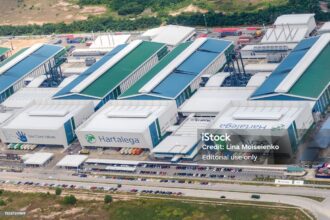
(Kualalumpur) — There is something almost absurd about the number 37 billion. That is the annual glove production capacity of Hartalega Holdings Berhad, enough to turn an object that is small and seemingly ordinary into a global business whose products reach customers across continents. Behind that number is a Malaysian company that began with a single production line and grew into one of the world’s major nitrile glove manufacturers.
The story began long before gloves became suddenly scarce during the Covid-19 pandemic. Kuan Kam Hon, Hartalega’s founder, started his career in construction in 1969 through Kuan Yuen & Sons Company, a house-building business in the Klang Valley. Nine years later, he moved into manufacturing through Timol Weaving Sdn Bhd, a producer of woven labels and badges, before establishing Hartalega Sdn Bhd in 1981.
Kuan did not enter the glove business with a large industrial conglomerate behind him. His career moved from construction to textile manufacturing and eventually to gloves. The sequence may look like a series of business experiments, but it also shaped a habit that would become central to Hartalega: test, improve and then build again.
Hartalega describes its early development as a transformation from a facility with a single production line into a manufacturer with its own production technology. The company built its reputation through manufacturing speed, automation and the development of nitrile gloves. Its production lines can now reach more than 45,000 gloves an hour.
Kuan appears to have understood something that manufacturing companies often learn only after years of competition: the advantage is not always in the product itself, but in the way the product is made. In 2004, Hartalega developed a double-former production line that could double output on a single line. That year, the company recorded a production speed of 28,000 gloves an hour, well above the industry average of about 10,000 units.
A year later, Hartalega introduced what it described as the world’s first lightweight nitrile glove, weighing 4.7 grams. The product became an important step in the evolution of the industry, offering greater sensitivity and comfort while maintaining protection. Several years later, the company introduced an even thinner nitrile glove weighing 3.7 grams.
In 2008, Hartalega moved to the Main Board of Bursa Malaysia. At the time, the company said it had captured about 20% of the U.S. synthetic glove market and around 10% of the global nitrile glove market. Two years later, after expanding capacity to roughly 10 billion gloves a year, Hartalega described itself as the world’s largest nitrile glove manufacturer.
Then came an even more ambitious expansion. In 2013, Hartalega began developing its Next Generation Integrated Glove Manufacturing Complex in Sepang with an investment of about RM2.5 billion, equivalent to roughly US$612 million at current exchange rates. The project was designed to move glove manufacturing toward a more automated, technology-intensive operation requiring a more highly skilled workforce.
The scale of Hartalega subsequently became difficult to ignore. Its production capacity reached 23 billion gloves a year in 2015 and 37 billion in 2018. That same year, Hartalega’s market capitalization reached roughly RM20 billion, or about US$4.9 billion at current exchange rates, placing it among Malaysia’s 30 largest companies by market value.
Then the world entered the pandemic. Gloves, which for decades had been routine equipment in hospitals, laboratories and industrial facilities, suddenly became symbols of a global supply shortage. Demand surged, selling prices rose and Hartalega became one of the manufacturers benefiting from an extraordinary period in the industry.
Hartalega’s revenue, which stood at around RM2.92 billion, or roughly US$714 million, in FY2020, surged to RM6.70 billion, or about US$1.64 billion, in FY2021. A year later, revenue reached RM7.89 billion, equivalent to approximately US$1.93 billion, while net profit climbed to around RM3.23 billion, or about US$791 million.
But the pandemic also created a familiar trap in commodity manufacturing: capacity built to satisfy extraordinary demand can become a burden once demand normalizes. Hartalega’s revenue subsequently fell to about RM2.41 billion, or US$589 million, in FY2023 and RM1.84 billion, or roughly US$450 million, in FY2024. Net profit in FY2024 fell to approximately RM12.5 million, or about US$3.1 million.
For a company that had recently generated billions of ringgit in profit, the post-pandemic period presented a different kind of entrepreneurial test. There were no longer customers rushing to buy whatever was available. What remained were older and harder questions: how much does it cost to make a glove, how much should a factory operate, and what price will customers actually pay?
Hartalega began answering those questions through efficiency. Revenue recovered to RM2.586 billion, or about US$632 million, in FY2025 before falling to RM2.135 billion, or approximately US$522 million, in FY2026. Yet net profit in FY2026 increased to around RM103 million, or about US$25.2 million, from RM74.5 million, or roughly US$18.2 million, a year earlier.
The change offers a glimpse of a different Hartalega from the company seen during the pandemic. With revenue lower, the company has had to become more disciplined about factory utilization, production costs, automation and product mix. In a business that sells billions of units, even a small improvement in efficiency can have a substantial effect when multiplied across enormous volumes.
Kuan has long emphasized the role of innovation in the company’s culture. Hartalega says its founder encouraged quality, creativity and innovation as management values, while the company has invested more than RM58 million, or about US$14.2 million, in research and development activities since FY2020. His son, Kuan Mun Keng, now the company’s Chief Business Officer, joined Hartalega in 1998 and became involved in sales, marketing and business development as the company expanded internationally.
There is something revealing about the way the Kuan family has developed the business. The company founded by its patriarch no longer depends on one major decision or a single product. It has become a manufacturing machine with annual capacity of 37 billion gloves, proprietary production technology, an international customer network and experience surviving two extremes: the global shortage during the pandemic and the excess capacity that followed.