




(Kualalumpur) –– Petroliam Nasional Berhad (Petronas), Malaysia’s state-owned oil and gas company, continues to expand its international portfolio through investments in liquefied natural gas (LNG), offshore oil and gas exploration, fuel distribution and lower-carbon energy. The strategy is becoming increasingly important as the company navigates commodity-price volatility, shifting energy demand and the need to sustain cash flows from long-term assets. Competing with global energy groups such as Shell, ExxonMobil, TotalEnergies and QatarEnergy, Petronas is seeking to strengthen its position as an international energy supplier by combining asset ownership, strategic partnerships and long-term supply agreements.
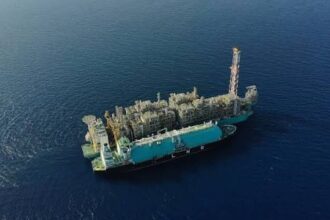
Canada has emerged as one of the most strategically important markets for Petronas’ overseas expansion. The company holds an interest in LNG Canada, an export terminal in Kitimat, British Columbia, with an initial combined production capacity of 14 million tonnes a year from its two liquefaction trains. Petronas holds a 25% interest in the project through North Montney LNG. LNG Canada shipped its first cargo in 2025, with Petronas’ first cargo departing for Japan on July 7 that year. The investment gives Petronas access to North American gas supplies and a direct export route to Asian markets, strengthening its long-term position in the global LNG business. (Source: Petronas and LNG Canada.)
Petronas’ next major move in Canada is the LNG Canada Phase 2 expansion, announced on September 29, 2026. The Canadian government put the overall investment value at C$33 billion, with the expansion set to double the facility’s capacity to 28 million tonnes of LNG a year. Petronas is one of the project’s shareholders alongside Shell, PetroChina, Mitsubishi Corporation and Korea Gas Corporation (KOGAS). The final investment decision would increase Petronas’ long-term exposure to the global LNG market, although the C$33 billion figure represents the overall project investment rather than the amount funded by Petronas alone. (Source: Government of Canada, September 29, 2026.)
Petronas has also restructured its Canadian asset ownership to create room for strategic partnerships and more efficient capital management. In September 2025, the company announced a strategic partnership with MidOcean Energy, an LNG company formed and managed by EIG. MidOcean acquired an approximately 20% equity interest in entities associated with the North Montney upstream business and LNG Canada. The transaction was completed in December 2025. Following the transaction, Petronas retained a 52% interest in North Montney Upstream Joint Venture and approximately 79.992% in North Montney LNG Limited Partnership, which holds Petronas’ participation in LNG Canada. The arrangement allows Petronas to share capital requirements while retaining control of strategically important assets. (Source: Petronas, 2025 financial reporting.)
Petronas is also expanding its access to LNG export infrastructure through a long-term agreement with Pembina Pipeline Corporation for the Cedar LNG project. Announced on November 5, 2025, the agreement gives Petronas the right to use one million tonnes a year of LNG liquefaction capacity for 20 years. The structure provides an additional export route for Canadian gas without requiring Petronas to finance the entire liquefaction facility directly. Cedar LNG supports the company’s strategy of securing long-term export capacity to serve customers across Asia. The agreement is a long-term capacity arrangement, rather than a direct equity investment in the project. (Source: Petronas and Pembina Pipeline Corporation.)
The United States is another important component of Petronas’ LNG supply diversification strategy. In June 2025, the company signed an LNG sale and purchase agreement with Commonwealth LNG to buy one million tonnes a year for 20 years from a proposed 9.5-million-tonne-a-year facility in Cameron, Louisiana. The agreement broadens Petronas’ potential supply sources beyond Malaysia and Canada. However, Commonwealth LNG was still under development when the contract was announced, meaning the long-term purchase commitment should be distinguished from a completed equity investment or an operating LNG production facility. For Petronas, contracts of this kind can increase trading flexibility and diversify its supply portfolio. (Source: Petronas, June 17, 2025.)
Indonesia remains an important market for Petronas’ upstream expansion in Southeast Asia. In February 2025, Petronas and Italian energy company Eni announced an initial agreement to explore the creation of a joint venture combining selected upstream assets in Indonesia and Malaysia. The companies estimated that the proposed entity could reach production of approximately 500,000 barrels of oil equivalent per day in the medium term, with combined resources of around three billion barrels of oil equivalent and additional exploration potential of approximately 10 billion barrels of oil equivalent. The plan focuses on developing new gas resources and improving operational efficiency. These figures represent targets and the potential of the combined portfolio, rather than incremental production already achieved. (Source: Petronas and Eni, February 27, 2025.)
Suriname is also gaining importance in Petronas’ international exploration portfolio. The company has reported securing three new exploration blocks in the South American country, expanding its presence in a region attracting growing interest from the offshore oil and gas industry. Suriname offers opportunities to develop hydrocarbon resources, but exploration carries geological risks, capital requirements and uncertainty over the timing of commercial production. For Petronas, exploration acreage represents an investment in future reserves rather than a guarantee of immediate revenue. Its economic value will depend on drilling results, commercial assessments and the company’s ability to develop discoveries at competitive costs.
Brazil illustrates a more integrated approach to international expansion, with Petronas active in offshore oil and gas production, marine services, lubricants and fuel distribution. In an update published in August 2025, Petronas said it participated in three producing fields and four deepwater exploration blocks in the country. Its lubricants business supplies more than 20 countries across Latin America and the Caribbean, while its branded fuel retail network had reached 30 stations at the time of that announcement. Petronas’ 2025 Integrated Report subsequently recorded an expansion of its branded fuel station network in Brazil to 102 locations through brand-licensing and retail solutions. The development illustrates how Petronas is seeking revenue from several segments of the energy value chain beyond oil and gas production. (Source: Petronas, August 2025, and Integrated Report 2025.)
In India, Petronas is extending its reach into the low-carbon energy supply chain through Gentari, its clean-energy business. One of its initiatives involves a 30% equity interest in AM Green Ammonia, a company developing a green ammonia business with its partners. The investment provides an opportunity to enter markets for lower-carbon fuels and industrial feedstocks, particularly in sectors where direct electrification is difficult. However, the commercial viability of green ammonia will depend on renewable energy costs, facility construction, transport infrastructure and the emergence of sustained customer demand. The investment reflects Petronas’ efforts to develop additional growth opportunities beyond conventional hydrocarbons. (Source: Petronas financial reporting.)
The international expansion is taking place as Petronas faces pressure on its financial performance. For the 2025 financial year, the company reported revenue of RM266.1 billion, down 17% from the previous year, while profit after tax fell 18% to RM45.4 billion. EBITDA declined 10% to RM103 billion. At the same time, the group recorded average production of approximately 2.423 million barrels of oil equivalent per day. These figures highlight both the scale of Petronas’ operations and the need for disciplined capital allocation. New projects must be assessed against their cash-flow potential, production costs, execution risks and ability to generate adequate long-term returns. (Source: Petronas, 2025 financial results, February 27, 2026.)
Ultimately, the success of Petronas’ overseas investments will depend on its ability to convert a global portfolio into sustainable earnings and cash flow. LNG Canada offers supply diversification and access to Asian markets, while projects in Indonesia, Suriname and Brazil provide opportunities for production growth and reserve development. North American LNG contracts expand its supply options, while green ammonia investments open a potential pathway into a changing energy market. The challenges are to control capital expenditure, avoid projects that fail to meet return targets and protect the balance sheet when commodity prices fluctuate. For Petronas, international expansion is not simply about operating in more countries. It is about building a portfolio capable of sustaining the company’s competitiveness in the global energy industry for decades to come.
INSIGHT :
- 01
- 02
- 03
- 04
- 05
- 06